
Markets were mixed in the first quarter of 2026. Earnings were strong but stocks fell on geopolitical jitters. Uncertainty surrounding events in Iran call up feelings of last Spring when unexpectedly broad tariff rates sent shocks through the financial system.
We each have an aversion to the unknown. When faced with the discomfort brought on by ambiguity, we may be tempted toward action, substituting clarity for optimality. Yet market history tells us that staying the course in the face of uncertainty often leads to above average outcomes.
The surest means of making sound decisions amid uncertain conditions is through preparation. The investor who knows what they own, protects cash reserves, and focuses on quality tips the scales in their favor. These principles allow us to acknowledge uncertainty for what it is rather than react impulsively in ways that undermine long-term outcomes.
As Spring enters full blossom, we turn our attention to four developing themes: a top heavy US stock market becoming healthier, dour sentiment setting the stage for positive surprises, and talk of burgeoning troubles in private loan markets.
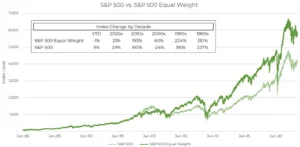
In the three years since 2022, the top seven market names accounted for 63%, 55%, and 46% of the S&P 500’s return. The market is now showing signs of broadening, steadily becoming less top heavy. The other 493 stocks in the S&P 500 returned -1% last quarter, compared to -5% for the whole.¹ Investors who remained patiently diversified are now being rewarded.
Despite market composition becoming healthier, investors and consumers alike remain persistently negative on the future.² Yet markets have a long history of moving opposite prevailing sentiment. This is partly due to our propensity to overreact to positive or negative news. As the saying goes, rarely is anything as good or bad as it seems.
Stocks zigging when sentiment zags also highlights the difference between Main Street and Wall Street. The stock market is neither designed to be, nor functions as, a direct proxy for the broader economy. Should earnings keep growing, all else equal, we would expect a positive market response despite a subdued backdrop continuing.
The ongoing conflict with Iran introduces a more tangible source of risk, primarily through its impact on global energy markets. Disruptions to key transit routes, particularly the Strait of Hormuz, have contributed to higher oil prices and renewed inflation concerns. While the range of outcomes remains wide, history suggests that even significant geopolitical events rarely alter the long-term trajectory of markets. The greater risk for investors is allowing uncertainty to drive reactive decisions, rather than staying anchored to fundamentals and long-term positioning.
Finally, private credit, an area we have avoided, has emerged as a growing source of concern for many.³ These funds lend money where traditional banks are unwilling or unable. Most recently, investors seeking the exit amid increased scrutiny of underlying risks have found the doors locked. While the system appears less leveraged and less systemically critical than housing prior to the financial crisis, similarities to 2008 warrant close monitoring for signs of broader contagion.
While the path forward is unlikely to be smooth, the core drivers of long-term returns remain intact. By maintaining discipline, staying diversified, and focusing on quality, investors can navigate periods of uncertainty with confidence. In the end, it is not the avoidance of volatility that leads to success, but the ability to endure it with a well-prepared plan.