

Perhaps you’ve had a reinsurance program in place for years. Premiums flow in month after month. Surplus accumulates. It’s a workable structure.
But as your dealership grows and evolves, you might find yourself asking a few new questions:
Is the B-Account positioned to maximize long-term growth?
Are distribution decisions coordinated with your broader tax picture?
Does the structure still align with how you’re thinking about succession or exit planning?
These aren’t problems. They’re opportunities. If you have someone who can see the full picture and outline how it integrates into your financial life as a dealership owner.
That’s where independent advice makes a difference. What’s often missing from reinsurance programs is a financial strategist who understands both the reinsurance entity and the dealership operations behind it. Someone who can help you make decisions that serve both.
Led by Jake Withnell, who comes from a family of third-generation auto dealers and specializes in reinsurance strategy, JGP provides that perspective.
What Is Reinsurance?
In the dealership context, reinsurance is a structure that allows dealer principals to participate in the underwriting profit generated by products sold in the F&I department (e.g., vehicle service contracts, extended service offerings, guaranteed asset protection), rather than ceding all of that value to third-party providers.
A reinsurance program gives dealership owners a way to capture, accumulate, and deploy surplus intentionally within an entity they control. In turn, it synchronizes economics, risk, and wealth planning, so long as the program is structured and managed properly.
Reinsurance vs. Third-Party Profit Sharing and Participation Programs
Many dealerships are familiar with profit-sharing arrangements and participation programs offered by third-party administrators, lenders, or insurance companies. While these can provide short-term income, they differ fundamentally from reinsurance.
With traditional profit sharing:
- The provider retains ownership and control of underwriting results and reserve management
- Participation formulas and payout terms may change over time
- Earnings are distributed periodically and taxed when received
- There is limited ability to manage surplus or plan beyond the current year
Reinsurance shifts control to the owner:
- The dealership (or an affiliated entity) participates directly in underwriting results
- Surplus accumulates inside a separately governed insurance entity
- Decisions around retention, investment, and distribution are deliberate
- Capital can be managed with a multi-year planning horizon
This distinction, control versus simple participation, is what transforms reinsurance from a compensation program into a strategic balance sheet tool.
Why Reinsurance Exists
F&I products tend to generate predictable, recurring economics over time, and those economics don’t need to be outsourced.
For dealership owners with sufficient scale and stability, reinsurance provides a way to not only retain underwriting profit and build surplus that can compound long term but also align tax strategy, liquidity planning, and wealth goals.
That said, reinsurance is not “set it and forget it.” Without oversight, value can stagnate—or worse, lead to unintended consequences.
Understanding the A-Account and B-Account
Most dealership reinsurance programs operate using a two-account structure, commonly referred to as the A-Account and B-Account.
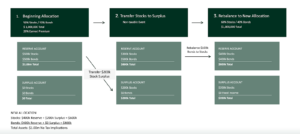
The A-Account: This account holds funds for unearned premiums and is reserved to pay future claims. It’s intentionally conservative, prioritizing liquidity and stability. Its purpose is protection, not growth.
The B-Account: This is where excess underwriting profit accumulates after claims reserves are met. The B-Account is invested and represents the long-term value of the reinsurance program.
Most of the strategic opportunity in reinsurance lives in the B-Account. How surplus is invested, governed, retained, and distributed determines whether the structure functions as a passive accumulation vehicle or a deliberate capital strategy.
Understanding how these accounts function (and how decisions affect them in the long run) is essential. It’s also where many programs begin to drift if no one is responsible for the full picture.
How Reinsurance Builds Wealth for Dealers
Each F&I product sold generates a premium. After acquisition costs, administrative expenses, and ceding fees are accounted for, a portion of that premium flows into the reinsurance structure.
Unlike discretionary savings or one-time capital contributions, this funding is systematic and recurring. Premiums arrive month after month, tied directly to dealership production. That consistency creates a steady capital base that compounds in the background of day-to-day operations.
Once claims obligations are adequately reserved within the A-Account, excess underwriting profit accumulates as surplus in the B-Account.
Surplus growth is driven by three forces:
- Recurring premium inflows tied to dealership production
- Favorable underwriting performance and disciplined claims management
- Intentional governance around retention and distribution decisions
Properly managed, surplus becomes a wealth-building vehicle, especially thanks to a structural advantage: tax deferral.
Surplus isn’t distributed annually as taxable income. Instead, it can remain inside the reinsurance entity, where it continues to grow. That deferral allows more capital to stay invested longer, driving compounding and after-tax performance.
Why Consistent Funding Is So Powerful
Reinsurance benefits from something most investment strategies struggle to replicate: dollar-cost averaging built into the business itself.
Premiums flow in regardless of financial market conditions. In strong markets, capital participates in growth. In weak markets, contributions continue at lower prices. Over long periods, that consistency reduces timing risk and supports disciplined accumulation without requiring constant decision-making from the owner.
Your Investment Policy—and Your Advisors—Drive Success
As reinsurance programs mature, complexity inevitably increases. Surplus grows. Investment exposure expands. Tax considerations evolve.
The remedy is structure and clarity. Namely, a defined investment policy statement (IPS), which establishes guardrails around risk tolerance, liquidity needs, time horizon, and distribution philosophy. Just as importantly, it clarifies who is responsible for investment decisions and how they’re evaluated.
Strategic advisors also play a critical role by ensuring the reinsurance program remains aligned with the dealership owner’s financial goals. Without that coordination, investment decisions made inside the reinsurance entity can inadvertently disrupt the rest of the plan.
Reinsurance builds wealth through consistency, discipline, and time.
Common Reinsurance Mistakes
Reinsurance programs are complex systems. When one or more cogs are out of order, the whole machine suffers.
| Area | Mistake | Impact |
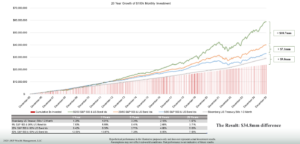
| Asset Allocation | B-Account funds are either underinvested or overly conservative. |
This is the primary long-term growth engine. Underutilization can result in millions of dollars in foregone compounding over time. |
| Surplus Management | The owner operates with an ad hoc distribution strategy. |
Poor timing can lead to unnecessary tax drag, push owners into higher tax brackets, and curtail growth. |
| Investment Policy Statement | Generic IPS documents are not applicable to reinsurance. |
Inconsistent decisions and weak governance limit your ability to maximize value and flexibility. |
| Multi-Entity Coordination | Multiple reinsurance entities may operate independently. |
Fragmented oversight creates unnecessary complexity, duplicated risk, and inefficiencies across the business. |
| Investment Transparency | Limited visibility into holdings and performance is common. |
Without real-time transparency, this can lead to poor decision-making and inertia in portfolios. |
The Most Common Reinsurance Structures (and What Dealers Need to Know)
The reinsurance framework can be implemented in different ways, each of which impacts control, taxation, governance, and long-term planning.
PARC, NCFC, Hybrid PARC, and DOWC Structures
It wouldn’t be finance without a handful of acronyms that look like alphabet soup. Most dealership reinsurance programs fall into one of four structures:
Producer Affiliated Reinsurance Company (PARC): A PARC is a dealer-owned reinsurance company that reinsures risks generated by its affiliated dealership(s). It may be domiciled offshore or in a U.S. jurisdiction, including Tribal domiciles. While PARCs provide a high degree of control and flexibility, they also introduce greater governance responsibility, tax complexity, and evolving regulatory scrutiny.
Non-Controlled Foreign Corporation (NCFC): An NCFC is a foreign-domiciled reinsurance company in which the dealer holds a minority ownership interest and participates in underwriting results without exercising full operational control. These structures are often used to access reinsurance economics while limiting direct governance responsibility. However, without clear governance and coordination, NCFCs can create confusion about who controls what, how value is accessed, and how the entity fits into the owner’s broader plan.
Domestic Owner Warranty Companies (DOWC): DOWC is a domestic C corporation that serves as the obligor on F&I products and is treated as an insurance company for federal tax purposes. Because it is formed within U.S. regulatory and tax frameworks, it often provides a greater sense of transparency and structural familiarity. That familiarity, however, should not be confused with simplicity. Domestic structures still require deliberate design and coordination. We frequently see DOWCs that are technically compliant but strategically misaligned — investment policies that do not reflect liquidity needs, ownership structures that complicate estate or succession planning, or surplus that accumulates without a defined capital strategy.
Hybrid PARC (Sometimes Called “Super CFC”): A Hybrid PARC, often referred to in the industry as a “Super CFC,” is a dealer-owned reinsurance company that operates under the 831(a) tax framework rather than the 831(b) election and may incorporate accounting mechanics similar to retail cost models.
Unlike traditional 831(b) micro-captives, Hybrid structures are not subject to annual premium caps. Underwriting income and investment income are taxed at corporate rates, but the absence of premium limitations allows the entity to scale alongside dealership growth.
These structures are often considered when:
- Production volume exceeds 831(b) thresholds
- Owners want to avoid premium aggregation constraints
- Long-term scalability is prioritized over micro-captive tax exclusion
While Hybrid models preserve structural flexibility, they also require disciplined reserve management, tax modeling, and investment governance to ensure that growth translates into efficient capital formation.
Whichever structure you choose, there are tradeoffs. The key is choosing a framework that aligns with how the reinsurance entity will be governed, accessed, and integrated into long-term financial planning.
Single vs. Multiple Reinsurance Entities
Some dealership owners operate a single reinsurance entity. Others use multiple entities.
A single entity can make sense in earlier stages or for owners with a simpler footprint. One or two rooftops. Stable ownership. Intent to accumulate surplus and reinvest methodically. In turn, a single structure is typically easier to manage.
Multiple entities could enter the picture as complexity increases:
- Additional rooftops are added under different ownership groups
- A family wants to separate economics across generations or branches
- Owners want to isolate risk or track performance by dealership
- Succession or estate planning begins to influence how value should flow
In those scenarios, segmentation can help, but each additional entity introduces more moving parts: governance, investment policy oversight, tax reporting, and coordination with personal financial planning.
The decision comes down to whether the structure supports how the dealership group is actually operating and where it’s headed. Scale, growth trajectory, ownership dynamics, and future planning intent should drive that decision. Without that context, additional entities may add complexity without delivering meaningful benefit.
Why Does Ownership Structure Matter?
The ownership of a reinsurance entity is not a technical detail. It shapes control, taxation, liquidity access, and long-term planning outcomes. Ownership may reside with:
- The individual dealer
- A family trust or estate planning structure
- A holding company or operating entity
- Multiple family members across generations
- Occasionally, select key employees
Each one affects who benefits economically, how control transitions, and how flexible the structure is if (and realistically when) circumstances change.
| Example: An owner structures the reinsurance entity to include key employees as minority participants as an incentive to aid retention. Years later, the dealership expands, the reinsurance program grows substantially, and succession planning becomes a priority.
Suddenly, questions emerge: Who controls distributions? How are departing employees handled? What happens to their economic interest if the dealership is sold or transferred within the family? Without clear ownership design and governance from the outset, the reinsurance entity can incite conflict and lead to operational disruption. |
Implications for Legacy, Estate Planning, and Employees
Reinsurance can become one of the most valuable non-operating assets a dealership owner controls. As a result, its structure plays an outsized role in:
Estate and legacy planning: Poorly configured ownership can complicate succession, create inequities among heirs, or force liquidity decisions at inopportune times.
Multi-generational planning: Structures designed without future generations in mind can limit options later, especially when governance and access to surplus aren’t defined.
Key employee participation: Involving employees in reinsurance economics can support retention—but only if structured carefully. Otherwise, it can introduce tax complexity or governance challenges that outweigh the intended benefits.
Because reinsurance structures are difficult to unwind once established, these decisions warrant careful consideration.
The Investment Side of Reinsurance
Premiums are the engine of the reinsurance structure. Investment strategy is the force multiplier.
Once surplus begins to accumulate, the long-term value of the entity is determined less by premium volume and more by how capital is allocated, governed, and reinvested. The critical question becomes whether the A- and B-Accounts are positioned to compound capital over time or merely preserve it.
The answer largely depends on your investment policy statement (IPS)—the governing document that dictates how capital is deployed, how risk is managed, and how decisions are made during periods of volatility.
In reinsurance entities, the IPS typically does one of two things:
- It establishes a disciplined structure that allows capital to compound over decades, or
- It locks the entity into an overly cautious strategy that prioritizes short-term comfort at the expense of long-term growth and performance
Many dealership owners gravitate toward conservatism for understandable reasons. This is business capital. Volatility feels unduly risky. Preservation seems prudent.
However, over extended time horizons, excessive caution carries its own form of risk: opportunity cost. When capital remains under-allocated relative to its time horizon and liquidity needs, the cumulative impact can be substantial.
Why Reinsurance Capital Is Fundamentally Different
Reinsurance investments should not mirror a typical portfolio. The objectives, constraints, and planning context are substantively different.
- First, premium inflows create a built-in form of dollar-cost averaging tied to the dealership production. Capital is added consistently across market cycles, which changes how risk should be evaluated over time.
- Second, the time horizon is longer and more flexible. Reinsurance capital can and should support future options, including liquidity events, succession planning, estate strategies, or post-dealership life.
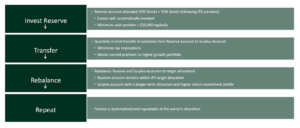
- Third, capital gains inside reinsurance entities are taxed at corporate rates. Frequent trading, unnecessary liquidations, or poorly coordinated reallocations can create tax drag that materially reduces the benefits of compounding. In some cases, portfolios can be repositioned without triggering immediate taxable gains, preserving more capital for future growth.
Taken together, these factors call for an investment strategy built specifically for insurance-based capital — one that integrates liquidity management, reserve requirements, tax efficiency, and long-duration compounding.

The Tax Advantages of Reinsurance
Reinsurance allows underwriting profits and investment returns to compound inside a separate entity before they’re ever introduced into a dealership owner’s personal tax picture. That deferral can enhance long-term value, but the advantages aren’t guaranteed without calculated planning around the deferral’s “how” and “when.”
How Tax Deferral Actually Works Inside Reinsurance
Premiums flow into the reinsurance company and are allocated between reserve accounts (designed to satisfy unearned premium and claim obligations) and surplus accounts (the true engine of sustained value). As long as earnings remain inside the entity, taxation generally occurs at the corporate level rather than the personal level. Personal taxation is typically deferred until funds are distributed to the owner.
This creates two important advantages:
- Time: Returns compound without immediate personal taxation.
- Flexibility: Owners decide how and when to access funds, instead of being forced into fixed distributions.
However, a deferral is not an exemption. Taxes eventually come due, most commonly through dividends or loans. Loans must also be structured carefully to avoid recharacterization or trigger tax consequences. That’s okay, so long as they’re coordinated with your personal financial picture. Otherwise, there could be unintended consequences.
For example, distributing surplus without factoring in personal income can push owners into higher marginal tax brackets. What looked like “tax-efficient” growth inside the reinsurance entity suddenly creates avoidable tax drag at the household level.
The same issue can surface in multigenerational planning. If ownership, beneficiaries, or succession timelines aren’t outlined, distributions may be forced sooner than intended, compressing taxable events and limiting flexibility for the next generation.
In both cases, the issue isn’t the reinsurance structure. It’s the absence of a holistic plan that accounts for how and when value eventually moves from the entity to the owner—or their heirs.
Retail Cost Accounting vs. 831(b): Choosing the Right Tax Framework
One of the most consequential tax decisions affecting a reinsurance or warranty structure is whether the entity operates under Retail Cost Accounting (commonly associated with DOWCs) or elects treatment under IRC Section 831(b). While both can be viable, they function very differently.
Retail Cost Accounting
Under the retail cost model, the entity records the full retail premium as written premium and deducts acquisition costs immediately. Premium is earned over the life of the contract.
Because acquisition costs are recognized upfront while revenue is earned over time, the entity often generates early net operating losses that offset future taxable income as premium is earned.
There is no statutory premium limitation under this framework, making it structurally adaptable as production grows. For expanding dealership groups, this scalability can be worthwhile.
Simple Example: How Retail Cost Accounting Creates Deferral
Assume:
- Retail cost: $2,000
- Acquisition costs: $1,300
- Contract term: 4 years
- Premium earned evenly: $500 per year
Year 1 (Issuance Year)
- Premium earned: $0
- Acquisition costs deducted immediately: ($1,300)
Tax result: ($1,300) loss
That loss becomes a Net Operating Loss (NOL).
Years 2–5 (Premium Earned Over Time)
Each year:
- Premium earned: $500
- No additional acquisition costs
The earlier $1,300 loss offsets future income:
- Year 2: $500 offset → NOL remaining $800
- Year 3: $500 offset → NOL remaining $300
- Year 4: $500 offset → $200 taxable
- Year 5: $500 fully taxable
IRC 831(b) Micro-Captive Election
The 831(b) election allows qualifying small insurance companies to be taxed only on investment income, rather than on underwriting income, subject to annual premium limitations and aggregation rules.
If properly structured and administered, this election can enhance early accumulation by reducing entity-level taxation on underwriting results. However, it carries tradeoffs:
- Annual premium caps ($2.9 million for year 2026, indexed for inflation)
- Controlled group aggregation rules
- Heightened compliance scrutiny
- Strategic constraints as production scales
As premium volume approaches or exceeds the threshold, long-term flexibility may narrow unless structural planning is addressed.
Simple Example: 831(b) Micro-Captive (4-Year Contract)
Assume:
- Retail cost: $2,000
- Acquisition costs: $1,300
- Contract term: 4 years
- Premium earned evenly: $500 per year
- Investment income: $50 per year
Under an 831(b) election, underwriting income is not taxed at the entity level. Only investment income is taxed.
Year 1 (Issuance Year)
- Premium earned: $500
- Acquisition costs: ($1,300)
- Underwriting result: ($800) loss
- Investment income: $50
Taxable income = $50
(Underwriting result does not affect taxable income under 831(b))
Years 2–4
Each year:
- Premium earned: $500
- No acquisition costs
- Underwriting profit: $500
- Investment income: $50
Taxable income each year = $50
(Only investment income is taxed)
Total Over 4 Years
- Total underwriting profit: $700
($2,000 premium – $1,300 acquisition costs)
- Total investment income: $200
($50 × 4 years)
- Total taxable income over 4 years: $200
(Only the investment income)
The Strategic Consideration
Retail Cost Accounting produces deferral through timing differences between revenue recognition and expense recognition.
The 831(b) election produces deferral by eliminating taxation of underwriting income at the entity level and electing to be taxed only on investment income, subject to strict qualification requirements.
Transitioning between frameworks can be complex and, in some cases, impractical without meaningful restructuring. For that reason, the initial decision should be modeled in the context of projected growth, ownership structure, estate planning goals, and long-term capital strategy.
The appropriate framework depends not simply on current premium volume, but on how the reinsurance entity is expected to function within the owner’s broader financial architecture.
When to Reevaluate Your Reinsurance Strategy
As dealerships evolve, the strategy surrounding reinsurance should evolve with them. The signs below indicate it’s time for a closer look.
You’re considering changing administrators. A transition is an opportunity to reassess whether the program is aligned with how you actually use it—not just how it was originally set up.
Your reinsurance investment manager has not proactively communicated in months. Reinsurance capital requires ongoing oversight, particularly as markets shift and surplus grows. Limited communication may indicate that the portfolio is operating on autopilot rather than being actively managed in alignment with reserve requirements, tax considerations, and long-term objectives.
You inherited the structure from a parent or prior generation. Many inherited programs were designed for a different era, scale, or risk profile. What worked for the previous owner may no longer support your liquidity needs or long-term goals.
Your F&I team and/or offerings have expanded. Changes in product mix directly affect premium flows, surplus accumulation, and risk exposure. If the reinsurance strategy hasn’t been revisited alongside those changes, it may no longer reflect the economics of the business.
You’re expanding your dealership footprint. Additional rooftops, acquisitions, or geographic growth are encouraging signs of growth, but it’s very possible to outgrow your current structure and strategy.
Your assets have grown materially. As surplus and invested capital increase, the cost of inefficiency can compound. It’s prudent to update strategies that were “good enough” early on.
Your advisor treats reinsurance like retail wealth management. Reinsurance capital is very different from personal assets. If investment decisions or risk management mirror a standard retail portfolio, the strategy likely isn’t optimized for the reinsurance industry.
Your investment policy statement hasn’t been reviewed in over two years. Markets change. Businesses change. Your life changes. If the IPS hasn’t changed too, that can lead to missed opportunities and blind spots.
You’re unsure whether in-kind transfers are being used—or could be. Lack of clarity here may signal gaps in coordination and tax awareness. Excessive liquidations can erode after-tax value.
If any of these sound familiar, we offer a complimentary review of reinsurance portfolios and structures.
Request a Portfolio & Structure Analysis
The JGP Difference: How the Right Advisor Unlocks Value
Reinsurance should be a reliable source of profits and wealth generation. Yet, many auto dealers operate programs that underperform for one primary reason: no one is overseeing the entire system—structure, cash flow, investments, taxes, and the impact on the owner’s finances.
That’s the gap JGP fills.
Deep Specialization in Dealer Reinsurance
Many advisors—even at large financial institutions—have never worked inside a reinsurance entity. They’re unfamiliar with premium flows, reserve mechanics, surplus accumulation, or the practical implications of in-kind transfers. As a result, reinsurance assets are often treated like a generic corporate account, when they should be managed as a strategic balance sheet in their own right.
At JGP, reinsurance is a core tenet of our firm. We evaluate structures in the context of how you actually operate and how you plan to use the program over time. We tailor investment strategies to premium inflows, corporate taxation, and long time horizons. And we help you make decisions with the entire lifecycle of the program in mind, from accumulation through eventual distribution or transition.
A Third-Generation Understanding of Dealership Operations
JGP brings a third-generation understanding of auto dealerships and their day-to-day realities: fluctuating margins across rooftops, variable F&I performance, reinvestment demands competing with personal liquidity, and the tension between growth, tax efficiency, and long-term exit planning.
Very few independent, fiduciary advisory firms on the West Coast work this closely with dealership owners. That operational fluency enables more cohesive planning and execution across both the business and personal sides of the balance sheet.
A Hands-On, Relationship-Driven Model
Dealers invest heavily in creating exceptional customer experiences. We bring that same level of intention, responsiveness, and follow-through to our client relationships. Clients have direct access to a team that intimately understands their financial picture and stays actively engaged as circumstances evolve.
Collaboration With Administrators and Agents
Most dealership owners already have accountants, attorneys, agents, and administrators. What they’re generally missing is a financial strategist at the center—someone responsible for seeing how all the pieces fit together.
JGP complements existing relationships, by becoming the third leg of the stool, providing independent oversight and strategic integration. Administrators handle mechanics. Agents handle placement. JGP ensures the structure, investments, and tax strategy align within the owner’s financial life.
How JGP Works With Dealers: Our Process
JGP’s process is designed to not only streamline reinsurance programs but also integrate them into the dealer’s personal wealth management.
Discovery and Structure Review
The process begins with a focused discovery conversation to understand how your reinsurance program was built, how it’s currently being used, and what role it’s expected to play going forward. This includes reviewing entity structure, ownership design, premium flows, and how the reinsurance program factors into your dealership operations and personal financial goals.
Analysis of A-Account, B-Account, and Surplus
We analyze how capital is allocated across reserve accounts, surplus, and invested assets. The objective is to understand function: how much capital is needed for claims, how surplus is accumulating, and whether investment strategy aligns with time horizon, risk tolerance, and long-term intent.
IPS Development
We work alongside your existing administrator to develop or refine an IPS that accounts for premium inflows, corporate taxation, liquidity needs, and governance expectations. In turn, all parties operate from the same framework and investment decisions remain consistent through market cycles.
Tax-Aware Investment Strategy
We design an investment strategy that’s tailored to you and your business. This includes evaluating asset location, turnover, potential use of in-kind transfers, and distribution timing to minimize unnecessary tax drag while preserving flexibility for future planning.
Ongoing Management and Transparent Reporting
Once implemented, our team provides ongoing oversight of investment performance, risk exposure, and alignment with stated objectives.
Quarterly Check-Ins and On-Demand Access
Reinsurance programs change, and so do dealership and personal circumstances. We conduct regular check-ins to review performance, revisit assumptions, and adjust strategy as needed. Dealers also have on-demand access when questions or decisions arise.
Reinsurance FAQs
What’s the difference between a reinsurance company and profit-sharing?
Profit-sharing arrangements typically pay a portion of underwriting profits back to the dealership as income. While this can support near-term dealership profitability, it effectively caps total potential value and planning opportunities.
With your own reinsurance company, underwriting profits (and investment returns on those profits) accumulate inside a separate entity. That setup provides more control over timing, investment strategy, tax deferral, and use of capital, making reinsurance a more strategic tool for sustained profitability.
Do I need a certain number of locations to justify reinsurance?
Not necessarily. Reinsurance viability depends more on premium volume and financial goals than on rooftop count alone. In the automotive space, a single-location dealer with strong penetration and disciplined execution may be better positioned than a multi-store group with uneven results.
Who manages my investments?
JGP oversees the investment strategy and ongoing management, working within the parameters of your reinsurance structure and investment policy statement. We coordinate with your administrator and agent to align investments with premium inflows, liquidity needs, and long-term objectives.
Do I need a CPA?
Yes. Reinsurance intersects with corporate taxation, personal income, estate planning, and sometimes multi-entity reporting. While JGP does not prepare tax returns, we work with your CPA to ensure investment decisions, surplus management, and distributions align with broader tax strategy and maximize the intended tax benefits of the reinsurance structure.
How liquid is the B-Account?
Liquidity depends on claims experience and reserve requirements. The B-Account is not designed for short-term spending, but, if managed properly, it can provide flexibility:
- Timing control: Surplus can remain invested during strong years and accessed selectively, rather than being distributed automatically.
- Income coordination: Distributions can support personal income needs, tax brackets, or transition timelines.
- Capital efficiency: In some situations, assets can be repositioned without triggering immediate liquidation of investments or avoidable taxation on gains tied to unearned premium transitioning into surplus.
What happens when I retire or sell my dealership?
That depends on how the reinsurance entity is structured. Reinsurance can support income replacement, legacy planning, or liquidity during a transition. However, those outcomes require advance coordination. Waiting until retirement or a sale is imminent can significantly limit available options.
What does it cost to work with JGP?
Fees depend on the scope and complexity of the engagement. JGP operates as an independent fiduciary and is compensated for advisory and investment management services—not through commissions or product placement. Fees are discussed transparently before any work begins.
How long does it take to restructure a reinsurance program?
Timing varies. Some changes can be implemented within months, while others—such as entity redesign, IPS changes, or tax-sensitive transitions—require more extensive planning.
Your Reinsurance Company Should Be One of Your Most Valuable Assets. Make Sure It Is.
A reinsurance program holds far more potential than most dealership owners realize. If it’s structured appropriately and governed intentionally, it can be a catalyst for long-term wealth.
If you’re unsure whether your current program is doing that or simply have a question, we’re happy to help.