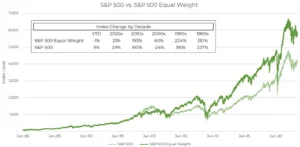

On June 14th, we wrote, “The concentrated rally in US markets this year isn’t out of the ordinary . . . Going back to 1990, the top three names by market cap (i.e. the largest stocks in the S&P 500) outperformed the market three and six months after a recession bear market.”
What happens next is where things get interesting. Historically, markets enter a broadening out phase where “the rest” outperform “the best.”
The chart below breaks down returns through May 31st. The ten best performing stocks accounted for over 100% of the gain in the market. Many were either oversold in 2022 or seen as beneficiaries of artificial intelligence. Sometimes both. And if you didn’t own all of them, chances are your portfolio trailed.

Since then, the same stocks have slowed down. From the end of May, the S&P 500 is up 10% with the majority of gains coming from the other 98% of stocks in the index. If history doesn’t repeat, it rhymes.

Sources: Bloomberg, Ycharts, FactSet
JGP Wealth Management is a registered investment adviser. This brochure is solely for informational purposes. Past performance is no guarantee of future returns. Investing involves risk and possible loss of principal capital. No advice may be rendered by JGP Wealth Management unless a client service agreement is in place.
This commentary reflects the personal opinions, viewpoints and analyses of the JGP Wealth Management employees providing such comments, and should not be regarded as a description of advisory services provided by JGP Wealth Management or performance returns of any JGP Wealth Management client. The views reflected in the commentary are subject to change at any time without notice. Nothing in this commentary constitutes investment advice, performance data or any recommendation that any particular security, portfolio of securities, transaction or investment strategy is suitable for any specific person. Any mention of a particular security and related performance data is not a recommendation to buy or sell that security. JGP Wealth Management manages its clients’ accounts using a variety of investment techniques and strategies, which are not necessarily discussed in the commentary. Investments in securities involve the risk of loss. Past performance is no guarantee of future results.